Are you someone who would truly benefit from having a curved or straight stair lift added to a stairway in your north Georgia home? Many people would enjoy much greater safety and comfort in their homes if they were to simply have a stair lift installed rather than believing some of the popular myths about stair lifts that serve as a discouragement.
Here we discuss a few of the more widely known myths about stair lifts that discourage people from making further inquiry about having one installed in their home:
Myth 1: Stair lifts are just for older people.
As I’m sure you have discovered, pain and mobility issues can affect anyone at any time. A stair lift provides accessibility at a time when mobility is needed, and restores accessibility to the whole house, and the outdoors.
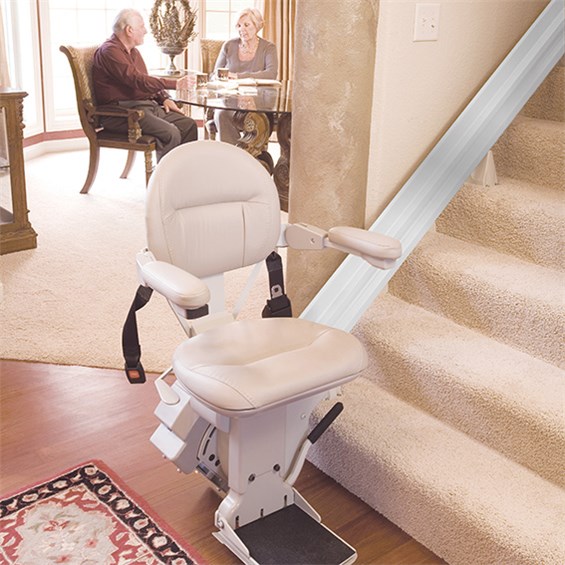
Myth 2: Stair lifts are too expensive for most people.
To have a straight stair lift installed in your home (for most stairways) can cost as little as $3,200. Most homeowners choose a model in the $3,200 to $3,500 range. Prices quoted will include materials, installation, the inspection and permit (required in the State of Georgia), and the warranty.
Myth 3: My stairs are too narrow for a stair lift.
Another popular myth about stair lifts is a concern that the stairs are too narrow. While we know this is a possibility, it is very unlikely. Today’s stair lifts fold up to a very compact size, as low as 11 and 12 inches when folded.
Myth 4: A new stair lift will make the stairway unusable for others.
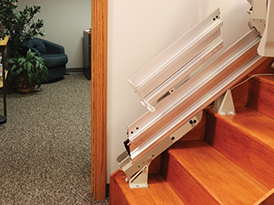
Again, this is no longer a concern with modern stair lifts. Today’s stair lifts come with a variety of options including an extended rail that wraps around a corner or portion of the stair railing at the bottom or top of the stair, so that the stairway is completely accessible when the stair lift is parked. Another option is a flip-up rail that can be added to a straight stair lift to remove the stair lift from the area when there is a doorway.
Myth 5: A stair lift installation will require construction or new electrical lines.
Thankfully, a new straight stair lift installation can be completed in two to three hours, and the installation does not impact the adjacent wall at all. The stair lift rail is mounted on the stairs, not on the wall. Assuming an adjacent outlet is available, no electrical lines need to be run. A curved stair lift can be completed in one day in most cases, and the case is the same regarding the electrical access.
More Things to Know Before Choosing a Stair Lift
Learning the facts about stair lifts can make it easier to decide whether one is appropriate for your home. The 5 common myths about stair lifts discussed above address several of the concerns homeowners frequently have, but there are other questions that often come up when someone begins researching stair lift options. Understanding the information presented in 5 common myths about stair lifts can help homeowners approach the decision with realistic expectations.
Stair lifts are designed with safety in mind
A stair lift is designed to provide a controlled way to travel between floors without requiring a person to walk up or down the stairs. Modern lifts include safety features intended to help provide a secure ride, including a seat belt, safety sensors, armrests, and controls that allow the user to operate the lift from the seat.
The specific features vary depending on the manufacturer and model. For that reason, it is important to consider the person’s individual needs when comparing stair lifts rather than choosing a model based only on price. Reviewing information such as 5 common myths about stair lifts can also help clarify which features are commonly available and which may vary between models.
A professional assessment can also identify characteristics of the staircase that may affect the installation. The number of steps, available landing space, stairway configuration, and location of doors or other obstacles can all be important when determining which type of lift will work best.
Straight and curved stair lifts are different
Another common source of confusion is the difference between a straight stair lift and a curved stair lift. A straight stair lift is generally used on a staircase that follows one continuous flight without a turn, intermediate landing, or other significant change in direction.
Curved stair lifts are designed for more complicated staircases. A custom rail can be manufactured to follow curves, turns, multiple flights, or changes in direction. This makes a curved system an option when a standard straight rail cannot follow the staircase.
The right choice depends on the layout of the home. A staircase with a landing or turn does not automatically mean that a stair lift is impossible. It simply means that the staircase should be evaluated to determine what type of system is appropriate. The 5 common myths about stair lifts information can be useful when sorting through common misconceptions about different stair lift configurations.
Stair lifts do not have to change the appearance of your home
Some homeowners hesitate to consider a stair lift because they are concerned about how it will look. While a stair lift does add equipment to the staircase, modern designs are relatively streamlined and are intended to fit along the stairway without requiring major changes to the surrounding area.
When the lift is not being used, the seat, armrests, and footrest can typically be folded to reduce the amount of space occupied by the equipment. Depending on the staircase and installation, other options may also be available to help with access at the top or bottom of the stairs.
The goal is to provide accessibility while allowing the staircase to remain useful for other members of the household. Information covered in 5 common myths about stair lifts can help homeowners understand what a stair lift installation may actually involve.
A stair lift is often the one solution to helping someone remain independent
One of the most important benefits of a stair lift is that it can provide continued access to different levels of a home. Someone who can no longer safely manage the stairs may otherwise begin avoiding an upstairs bedroom, bathroom, office, or other part of the house.
A stair lift can provide an alternative to repeatedly climbing stairs when doing so has become difficult or unsafe. This can be particularly helpful for homeowners who want to continue living in a multilevel home rather than moving solely because the stairs have become a barrier.
A stair lift may also be useful as a temporary accessibility solution. Mobility can change because of an injury, surgery, or other circumstances. The appropriate solution depends on the person’s situation and expected needs. Understanding 5 common myths about stair lifts is another way to learn more about how stair lifts may fit into different accessibility situations.
Professional Installation Matters – not a Do-It-Yourself Project
Even when a stair lift appears relatively simple, installation should be handled by someone familiar with stair lift systems. The rail must be positioned correctly, the equipment must be securely installed, and the completed system should be checked to ensure that it operates properly.
A professional home assessment also provides an opportunity to discuss practical issues that may not be obvious from photographs alone. These can include where the user will transfer onto and off the lift, whether the seat needs to swivel, where the lift should park, and whether an obstruction affects the installation.
When reviewing 5 common myths about stair lifts, it is important to remember that general information cannot replace an evaluation of the actual staircase. Installation requirements can vary from one home to another.
Ask Important Questions Before Purchasing a Stair Lift
When researching stair lifts, homeowners should feel comfortable asking questions about the equipment, installation process, warranty, service, and the specific staircase in their home. A consultation can help explain the differences between straight and curved systems and identify options that may be appropriate for the staircase.

The purpose of researching topics such as 5 common myths about stair lifts is not simply to find a particular model. It is to understand what is possible and determine whether a stair lift can provide a practical accessibility solution for the home.
Learning about 5 common myths about stair lifts can also help homeowners prepare useful questions before speaking with a stair lift professional. Rather than relying on assumptions, homeowners can discuss the actual staircase, the user’s needs, and the features that may be appropriate with the stair lift expert.
If you are shopping for a safe stair lift in: Atlanta, Hoschton, Johns Creek, Kennesaw, Marietta, or Sandy Springs, look no further! Contact us today to learn more about stair lift options at 770.880.3405, or submit your information in the contact form below, and we will call you.
Are you looking for other home accessibility options such as ramps, roll-in showers, walk-in tubs or roll-under sinks?